Over the past decade, academic research has increasingly examined issues of multitasking and distraction as people try to squeeze more activities into their busy lives. Prior to the Internet age, some cognition science research focused on how behavior might be better understood, improved and made more efficient in business, hospital or other high-pressure settings. But as digital technology has become ubiquitous in many people’s daily routines — and as multitasking has become a “lifestyle” of sorts for many younger people — researchers have tried to assess how humans are coping in this highly connected environment and how “chronic multitasking” may diminish our capacity to function effectively.
Google has added a new feature to Search that will show you if your local library has the ebook you’re looking for in stock. If you’re old like me and didn’t know that you could borrow ebooks, well you can, and many libraries across the US have a digital collection that you can borrow from….
The term “curate” has become a buzzword in education. I’ve seen it referenced in TEDx Talks and tossed around in Twitter chats. It’s easy to write off buzzwords as trendy. But what if an idea is trending for a reason? We live in a world of instant information, where ideas go viral without much thought…
Fans of Douglas Adams’s Hitchhiker’s Guide to the Galaxy treasure the bit where a group of hyper-dimensional beings demand that a supercomputer tells them the secret to life, the universe and everything. The machine, which has been constructed specifically for this purpose, takes 7.5m years to compute the answer, which famously comes out as 42….
The world as a whole has become increasingly reliant on science to provide its technology and inform its policy. But rampant conspiracy theories, fake news, and pseudoscience like homeopathy show that the world could use a bit more of the organized skepticism that provides the foundation of science. For that reason, it has often been…
When my son started middle school last month, he brought home a slew of consent forms for this that and the other. Most weren’t problematic, but one was deeply troubling to me — the consent form for the Google Education App. In accordance with the Freedom of Information and Protection of Privacy Act, the form…
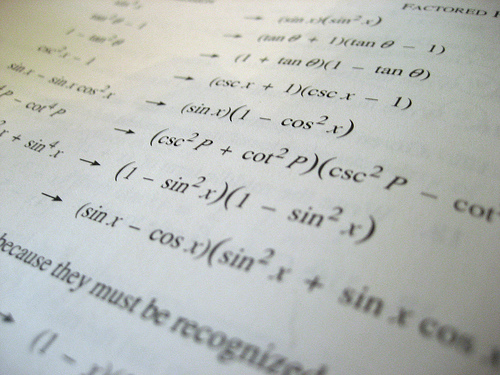
My son struggled with required math classes in both high school and college, as did I. And suspect both of us are somewhere within one standard deviation of a normal IQ. Politically-driven, nonsensical math requirements probably make me angrier than almost anything else in education right now. To think of the millions of lost classroom…